


Clinical Trial Feasibility: How To Forecast (Formulas & Calculator Included)



In a review of 2,542 surgical trials, only 20.4% finished within the timeframe they had planned, and the trials that ran late overran by a median of 12.2 months [1]. Clinical trial feasibility is a routine step before a trial opens, so that figure is hard to explain away: the forecasts are being made, and they still miss. The fix starts with how the forecast is built. Three formulas, each worked backwards from your randomization target, show how many patients you need to screen, how many you need to find and how long your sites will take to enroll them, and a calculator lets you test your own numbers.
Clinical trial feasibility at a glance
The published record shows a pattern: trials are planned around the enrollment their sites promise, and they run late when that promise outruns what the patient funnel can deliver.
- Only 20.4% of 2,542 surgical trials finished within their planned timeframe, and fewer than half (45.9%) met their enrollment target [1].
- In a Tufts CSDD study of nearly 16,000 sites, about 11% of activated sites enrolled no patients and only 59% met or exceeded their targets [2].
- In the same Tufts CSDD benchmark, 53% of studies had to extend their enrollment period [2].
- Across 151 publicly funded UK trials, the median recruitment rate was 0.92 participants per site per month [3].
What clinical trial feasibility covers
Clinical trial feasibility is the work of testing, before a trial opens, whether its protocol can be run, enrolled on time and finished on budget at the sites chosen for it. That means checking the plan's assumptions against real data instead of best guesses, above all how many eligible patients exist, how many will consent and how quickly sites can screen them.
The term also has a second meaning that sends many readers to the wrong answer: a feasibility or pilot trial is a small study run to test methods and procedures, not powered to answer the main scientific question. This guide is about the operational assessment that decides whether the real trial can deliver what its timeline promises.
How to estimate whether you can recruit enough patients
To estimate whether you can recruit enough patients on time, start from the number you need to randomize, work backwards through every stage where patients drop out, and then divide by the pace your sites can sustain.
A feasibility forecast that stops at a site telling you "we see 200 of these patients a year" is looking only at the top of the funnel. It counts the patients who come through the clinic door and misses every point at which they fall away: the ones who don't pass pre-screening, the ones who decline consent and the ones ruled out at the screening visit. That narrow view is often the first sign a timeline is in trouble, because enrollment is a funnel, and the number of patients still in contention shrinks at every stage on the way down to randomization.
A sound feasibility assessment usually covers the elements that decide whether a protocol can run on time and whether it justifies its funding. These include, but aren't limited to:
- the eligible patient population
- the protocol's burden on patients and sites
- site staff and equipment
- competing studies drawing from the same patient pool
- regulatory and ethics review timelines
- budget
To decide whether those elements add up to an enrollment plan you can deliver, most teams rely on three calculations. Each one answers a different question, so the first step is knowing which question you're asking.
Formula 1: Screens needed shows how much work screen failure adds
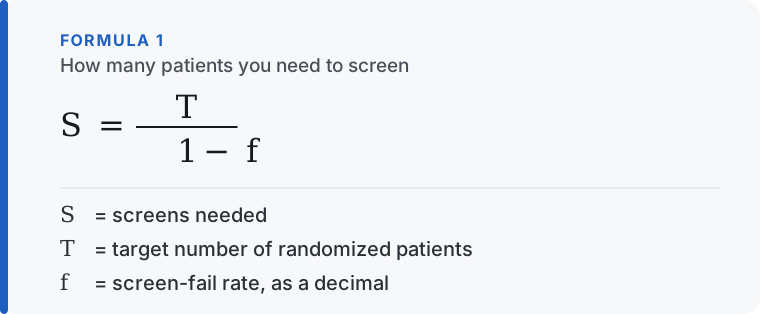
The simplest of the three divides your randomization target by the share of screened patients who pass [4]. If a trial needs 100 randomized patients and 30% of screened patients fail, the sites need to screen about 143 people, not 100, and every one of those extra 43 screening visits costs coordinator time and site budget that no headcount shows.
Reach for this formula first, at protocol review, when eligibility criteria are still being written, because it shows what a tight criterion costs in screening workload. It also tests a site that promises randomized patients without saying how many it expects to screen.
Formula 2: Patients to identify tells you whether the pool is big enough
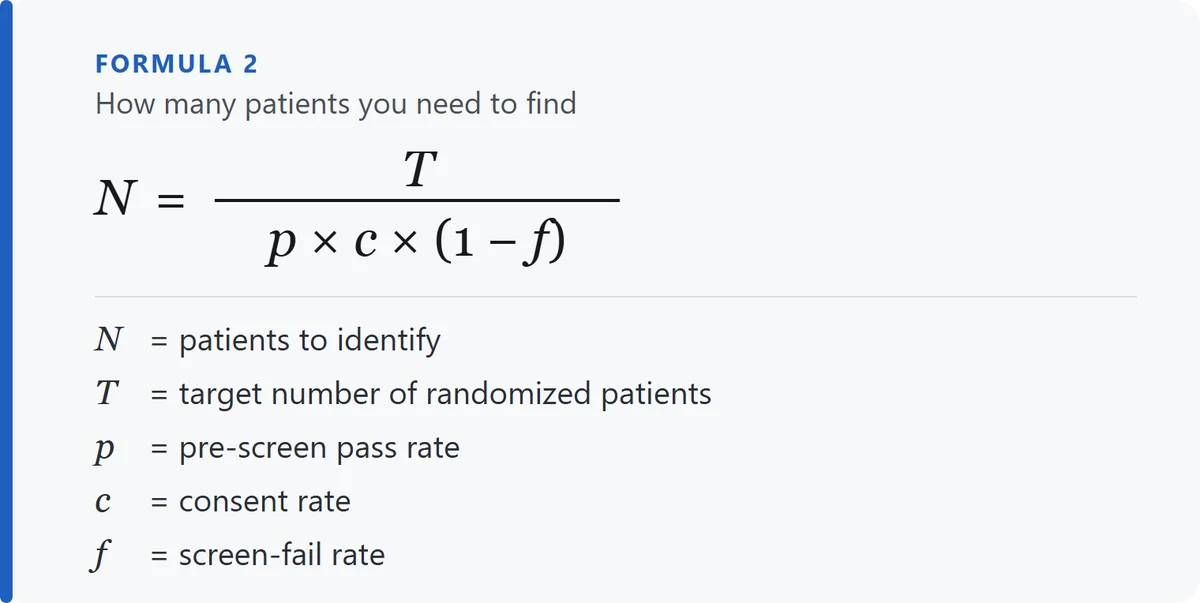
The second formula extends the first back to the top of the funnel, since expected screens on their own understate the work and planning guidance notes that real forecasts also need pre-screen attrition and consent rates [4]. Using illustrative rates, if 40% of identified patients pass pre-screening, half of those consent and 30% then fail screening, a trial needing 100 randomized patients has to find about 715 candidates. Replace those placeholder rates with the site's own records or a published figure for your therapeutic area, because a rate borrowed from a different indication or phase is a guess with a decimal point.
Use this one when the question is whether the patients exist at all. It is the number to hold up against a site's database counts or catchment claims, and it shows whether you need outside recruitment support to widen the top of the funnel.
Formula 3: Months to enroll puts the deadline into the math
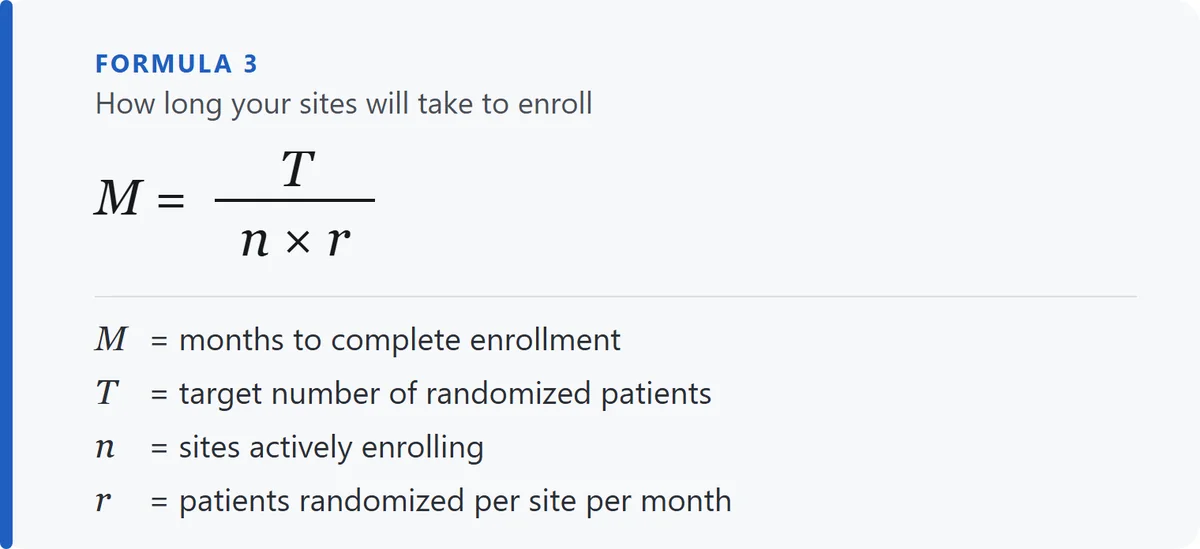
The third formula is the only one with time in it. It divides your target by the combined monthly output of your sites, using the recruitment rate that trial researchers measure as participants per site per month [3]. Ten sites each randomizing 0.9 patients a month would need a little over 11 months of full enrollment to reach 100, and since the published UK median is also below one patient per site per month [3], a site promising three or four should be able to show where it has sustained that pace.
Use this formula when you are deciding how many sites to open or whether the deadline is realistic. It assumes every site enrolls from the first day, which never happens, so add activation time and treat the result as a range rather than a date, as planning guidance recommends [4].
Try the numbers yourself
The calculator below runs all three formulas, plus a fourth that works out how many sites you need to hit a fixed deadline. Enter your own rates and treat every result as a starting point to pressure-test, since each rate is an assumption until a site's enrollment records back it up.
The site questionnaire is where most of these inputs come from
The primary tool for gathering those rates is the site feasibility questionnaire, which sponsors and CROs send to candidate sites before selection. It asks about patient counts, investigator experience, staff, competing studies and past enrollment, and the answers are used to shortlist sites and allocate enrollment targets. The catch is that every answer is self-reported, which is why the formulas matter: they turn a site's claim into a number you can check.
Who owns each level of feasibility
Feasibility runs at three levels, and each one belongs to a different party asking a different question.
Sponsors are deciding whether the program is worth funding at all. Before major money is committed, a sponsor is asking whether the program can produce a credible result within a time, cost and level of risk it can live with. That answer feeds the go or no-go decision, the choice of indication and countries, and the budget, so an optimistic assumption made here travels into every plan built on top of it.
CROs are turning a protocol into a plan they will be measured against. A CRO's feasibility work converts the protocol into a country mix, a site list and an enrollment curve. When that plan forms part of a bid for the work, there is a natural pull toward a timeline the sponsor will be happy to accept, so ask which assumptions the CRO would still stand behind if the first sites underperform.
Sites and principal investigators are deciding whether the study is worth their time. A site weighs the protocol against its staff, its patients and the other studies already competing for the same people. The principal investigator signs off on the answers, but a site that says yes stays in contention for the study, which is one reason its estimate is best read as a forecast to verify rather than a commitment.
Why feasibility doesn't prevent enrollment delays
Feasibility assessments are routine, yet the published data show enrollment running late anyway. In the surgical-trial review, fewer than half of the trials met their enrollment target, and the completed trials that fell short missed it by a median of 31% of their planned sample [1].
Does that mean feasibility is treated as a compliance exercise to get through before start-up? That seems unlikely, since the sponsors, CROs and sites running these assessments know what they are for. The results point instead to weak assumptions, incentives that reward optimism, and methods that stop at a single headcount.
Consider a site that says it can recruit 100 patients. That may well be true, eventually, but it does not mean the site can do it within 12 months alongside competing trials, screen failures and staff turnover. Feasibility does its job when it exposes that gap before the first site opens, and it fails quietly when the questionnaire answer is accepted as the forecast. If you need to put a price on that failure, the breakdown of clinical trial recruitment costs per patient, per site and per delay day shows what each month of delay costs.
Testing site feasibility answers against past performance
The first check on a site's feasibility answer is what the site enrolled the last time it ran a comparable study. The Tufts CSDD figures above, where roughly one activated site in nine enrolled nobody, are the reason to ask [2], because a confident questionnaire is not a track record and only the history tells them apart.
Put these questions to each site, beyond the standard questionnaire:
- How many patients did you enroll in your last comparable trial, and how long did it take from activation to the first patient?
- What was the screen-fail rate in that trial?
- How many competing studies are recruiting from the same patient population at your site right now?
- Where do your patients come from: physician referral, a registry, electronic health records or an outside recruitment partner?
Then convert the site's last trial into a monthly rate and compare it with what the site is promising now; if the new promise is double the old performance, ask what has changed. Ask too for stage-level numbers, from identified through pre-screened, consented and screened, because a single headcount hides the stages where the delays happen.
What to do when clinical trial feasibility falls short
When the formulas show a gap between what you need and what your sites can deliver, four levers can close it before start-up, and each one fixes a different part of the funnel.
Loosen eligibility criteria that don't protect patient safety
If your screen-fail rate is high, start with the criteria, because every exclusion criterion rules more patients out at the screening visit and criteria drawn tighter than safety requires inflate every number in Formulas 1 and 2. FDA guidance encourages sponsors to consider broadening eligibility to enroll a wider population, provided safety and the trial's scientific objectives are not compromised [5]. Rerun Formula 1 with the revised screen-fail rate to see how much workload each change removes. This is not legal advice; confirm any change with regulatory counsel and the IRB of record.
Add sites, or replace the ones with no enrollment history
If Formula 3 shows the deadline is out of reach, the most direct fix is more sites, or better ones. Treat the site count the calculator gives you as a floor, since some sites will activate late and, on the Tufts CSDD evidence, some will enroll no one at all [2]. Favor sites that can document their past enrollment over sites that can only describe their catchment.
Bring in a recruitment partner that reports every stage of the funnel
If Formula 2 shows the pool your sites can reach is too small, an outside recruitment partner can widen the top of the funnel. Insist on reporting at every stage from referral to randomization, because a partner that reports only leads shows none of the drop-off that decides your timeline. The guide to the six patient recruitment vendor types and how they price covers what you would be buying, and the clinical trial patient recruitment benchmarks show which recruitment strategies have evidence behind them.
Rerun the numbers before switching to a decentralized or hybrid design
If you are considering a decentralized or hybrid design, it changes the site footprint and every rate in the formulas, so it needs its own feasibility pass rather than a quick adjustment to the old one. The evidence on enrollment speed and dropout in decentralized trials is worth reading first.
Settle three decisions before the first site opens
Feasibility should end in three decisions: whether the protocol, the site list or the recruitment plan needs to change. If you would rather not run that evaluation alone, Refero screens healthcare marketing and patient recruitment agencies against five published criteria and introduces up to three that fit your brief. It is free for buyers, and there is no obligation to hire anyone we introduce. Tell us what you need.
Frequently asked questions
How do you measure the feasibility of recruiting enough patients?
Work backwards from your randomization target. Divide it by the share of patients who pass screening to get the screens you need, then by the pre-screen pass and consent rates to get the patients you need to find [4]. Divide the target by your active sites times their monthly enrollment rate to get the months enrollment will take, and check every rate against the sites' past performance.
Who prepares a feasibility study for a clinical trial?
The sponsor or contract research organization drives program-level and protocol-level feasibility, assessing whether the indication, eligibility criteria and study design can support enrollment. Sites complete site-level feasibility, usually through a questionnaire on patient counts, staff and past performance, and the principal investigator signs off on what the site claims.
What are the main elements of a clinical trial feasibility assessment?
The core elements are the eligible patient population, protocol design and visit burden, site staff and equipment, competing trials, regulatory and ethics review timelines, and budget. Generic business feasibility lists add market analysis and cash flow, but clinical feasibility turns on whether enough patients can be enrolled on time at the chosen sites.
What is the difference between a feasibility assessment and a pilot or feasibility trial?
A feasibility assessment is an operational evaluation carried out before a trial opens, checking whether the protocol, sites and recruitment plan can deliver enrollment on time. A pilot or feasibility trial is a small clinical study that tests methods and procedures but is not powered to answer the main scientific question.
What is a realistic recruitment rate per site?
It depends heavily on the indication, phase and site, which is why a site's own history beats any average. As one published reference point, a review of 151 publicly funded UK trials found a median of 0.92 participants recruited per site per month, with the middle half of trials ranging from 0.43 to 2.79 [3].
Sources
- [1] Shadbolt C, Naufal E, Bunzli S, et al. Analysis of Rates of Completion, Delays, and Participant Recruitment in Randomized Clinical Trials in Surgery. JAMA Network Open, 2023. Link
- [2] Getz KA. Enrollment Performance: Weighing the "Facts." Applied Clinical Trials, 2012. Link
- [3] Walters SJ, Bonacho dos Anjos Henriques-Cadby I, Bortolami O, et al. Recruitment and retention of participants in randomised controlled trials: a review of trials funded and published by the United Kingdom Health Technology Assessment Programme. BMJ Open, 2017. Link
- [4] Council on Pharmacy Standards. Section 9.2: Enrollment Prediction and Feasibility Simulation. CAIDRA examination materials, 2026. Link
- [5] FDA. Enhancing Participation in Clinical Trials: Eligibility Criteria, Enrollment Practices, and Trial Designs. Guidance for Industry, 2025. Link
More from Refero