


The Complete Guide To Clinical Trial Advertising (With Example Ads)



Please note that the information in this article does not constitute legal advice; confirm with regulatory counsel and the IRB of record.
Google permits clinical trial recruitment ads in 22 countries and only from advertisers it has approved [1]. Microsoft Advertising has not accepted them anywhere since August 1, 2023 [2]. No institutional review board (IRB) checks either rule.
In clinical trial advertising, an IRB approval letter is the first of three approvals every ad needs. Next comes the ad platform, then the privacy and contact rules that govern what happens after the click. The three reviewers do not always agree.
Refero vets and match the clinical research marketing agencies that run recruitment campaigns, so what follows is written for the buyer, from what those vendors need and see.
Clinical trial advertising at a glance
Every figure here is sourced in full at the foot of the page.
- Approval 1, the IRB: FDA treats advertising for study subjects as the start of informed consent and subject selection, so the IRB reviews the ad [3]
- Approval 2, the ad platform: Google accepts trial recruitment ads in 22 countries from approved advertisers only, and bars any implication that the tested product is safe [1]
- Approval 3, privacy and contact law: Each call that breaks the TCPA's consent rules can carry $500 in statutory damages, up to three times that if willful or knowing [5]
Why IRB review matters: In one 2007 analysis of 119 online ads for healthy volunteers, 18% were ethically troubling in font size, style or wording, and 47% stated a dollar amount [4]
Approval 1: What counts as a clinical trial ad
Any asset that invites a prospective participant into a study counts, from the search ad through the landing page, prescreener, call script and follow-up text. The IRB reviews each asset's content and mode of communication [3].
IRB review is not required for internet listings limited to basic trial information such as title, purpose, eligibility, locations and contact details [3]. Under one university IRB's policy, a basic listing needs IRB review once it adds payment, risks or benefits, or asks for identifiable information [6].
Prescreeners go to the IRB too. FDA asks IRBs to review the scripts used to check basic eligibility, including how personal answers are handled [3]. Clinical screening procedures done only to check eligibility need consent first, and the IRB should receive a written outline of the screening procedure [7].
Recruitment vendors typically start with an asset register that maps every asset version to the approval covering it.
Table 1. Which recruitment assets need which approval.
What the IRB reviews in a trial ad
The IRB checks that an ad carries only what a person needs to judge eligibility and interest. Under 21 CFR 56.109, it can approve the ad, require changes, or disapprove it [8].
FDA guidance lists items an ad may include, such as the investigator's name and address, the condition and purpose of the research, and an eligibility summary. Ads may also give a brief list of benefits such as a no-cost health examination, the time commitment, and contact details [3]. Four things draw a strike:
- Claiming or implying that the product is safe, effective, or equivalent or superior to another
- Calling it a new treatment, medication or drug without saying it is investigational
- Promising free medical treatment when the meaning is no cost to take part
- Promising a certainty of cure beyond the consent form and protocol [3]
Payment may be stated, but not emphasized with larger or bold type [3]. FDA classes payment as a recruitment incentive that IRBs review for undue influence [9]. An IRB may judge a specific amount coercive and allow only a statement that compensation will be offered [10].
Under 21 CFR 50.20, consent may be sought only in circumstances that minimize the possibility of coercion or undue influence [11]. Under 21 CFR 56.111(a)(3), IRB approval requires equitable selection of subjects, and 56.111(b) adds safeguards for groups vulnerable to coercion [12].
The IRB reviews final print copy for type size and the final recording for broadcast [3]. 21 CFR 56.108(a)(4) requires IRB review and approval before any change to approved research. The one exception is a change needed to remove an apparent immediate hazard to subjects [13].
Shortening an ad for a character limit can change what it says. At least one university IRB expects a truncated post to keep the spirit of the approved wording. It calls a post that carries only the payment inappropriate [14]. Recruitment vendors therefore aim to submit every platform variant in the first IRB package.
Approval 2: Where clinical trial ads can run: Google, Meta and other channels
An IRB approval obliges no platform to run the ad; each applies its own rules afterward.
Google's policy bars prescription drug promotion, misleading expectations and any implication that the tested product is safe [1]. Vendors typically check its country list before building the media plan, because a multi-country trial can lose Google paid search in several markets.
Meta's personal attributes policy bars copy that asserts or implies a viewer's physical or mental health [15]. Its own examples show where the reviewers collide. "Do you have diabetes?" is a violation and "New diabetes treatment available" is acceptable, yet FDA advises against "new treatment" without the word investigational [3][15].
LinkedIn allows trial recruitment ads only when they target healthcare professionals, which suits physician-referral outreach [16].
Search mostly reaches people already looking for a study; social mostly reaches people who were not, so social copy has to explain what the study is. Survey data shows a wide gap between where patients actually see trial information, and where they want to.
Many vendors name the study site in the ad, which FDA's list of permitted items allows [3]. They also show the ClinicalTrials.gov identifier on the landing page, so readers can confirm the study is registered.
Table 2. Channel rules for clinical trial ads, checked September 2026. Platforms change policies without notice, so recheck before launch.
Approval 3: Privacy and contact rules after the click
Once someone responds, the campaign contacts a person and collects health information, under contact and privacy laws that neither the IRB nor the platform checks.
The TCPA bars calls to mobile numbers that use an autodialer or an artificial or prerecorded voice, unless the caller has prior express consent [17]. In February 2024 the FCC confirmed that AI-generated voices count as artificial voices, so AI callback systems need the same consent [18]. FCC rules apply the consent and opt-out provisions to text messages too [17]. Vendors typically put the consent language on the prescreener form, include it in the IRB package and store it against each lead.
A HIPAA covered entity can use or disclose protected health information for research only through a named pathway. Examples include the individual's authorization or an IRB or privacy board waiver [19][20].
On tracking, federal and state law point in different directions. In June 2024 a federal court vacated part of HHS's tracking-technology bulletin. That part had treated an IP address plus a visit to an unauthenticated health-condition page as individually identifiable health information under HIPAA [21].
Washington's My Health My Data Act regulates consumer health data. Any violation is a per se violation of the state Consumer Protection Act, open to Attorney General enforcement and private action [22]. Vendors typically keep advertising pixels off pages that collect health answers.
This is not legal advice; confirm with regulatory counsel, the IRB of record and the covered entity's privacy officer.
Clinical trial advertising examples
These are structures to brief from; the IRB of record approves the final wording of any ad.
Sample 1: Augusta University
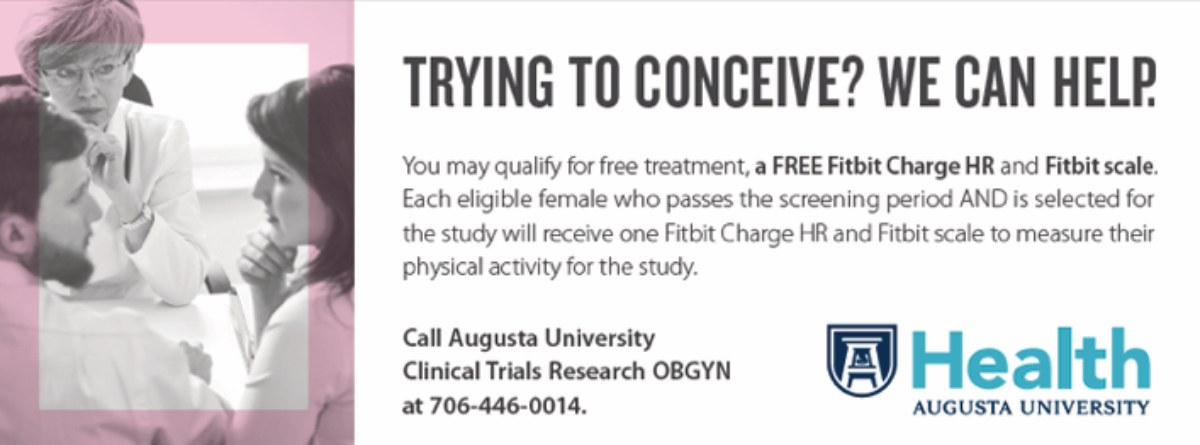
Augusta University Health published a clinical trials advertising toolkit that set house rules for recruitment ads [25]. Ads had to say "research study", carry the IRB number and study team phone number, and describe the time commitment. They could state only that compensation was available, and the marketing division allowed 72 hours for approval [25].
The toolkit's example from the OBGYN clinical trials research team opened "Trying to conceive? We can help." It offered free treatment plus a Fitbit Charge HR and Fitbit scale to each eligible woman selected, and closed with the team's phone number.
Why it worked: The headline spoke to the reader's goal in her own words, and the body explained who qualified and what the Fitbits were for: measuring physical activity during the study. One phone number and the university's brand gave a clear, trusted next step, as the toolkit required of every ad [25]. For buyers, the lesson is that print copy can speak directly to the reader's situation. The same question headline would have failed Meta's review [15], and an IRB would have checked the bold "free" wording against FDA guidance on promising free treatment [3].
Sample 2: Tetra Discovery Partners' Facebook ad for healthy volunteers over 60
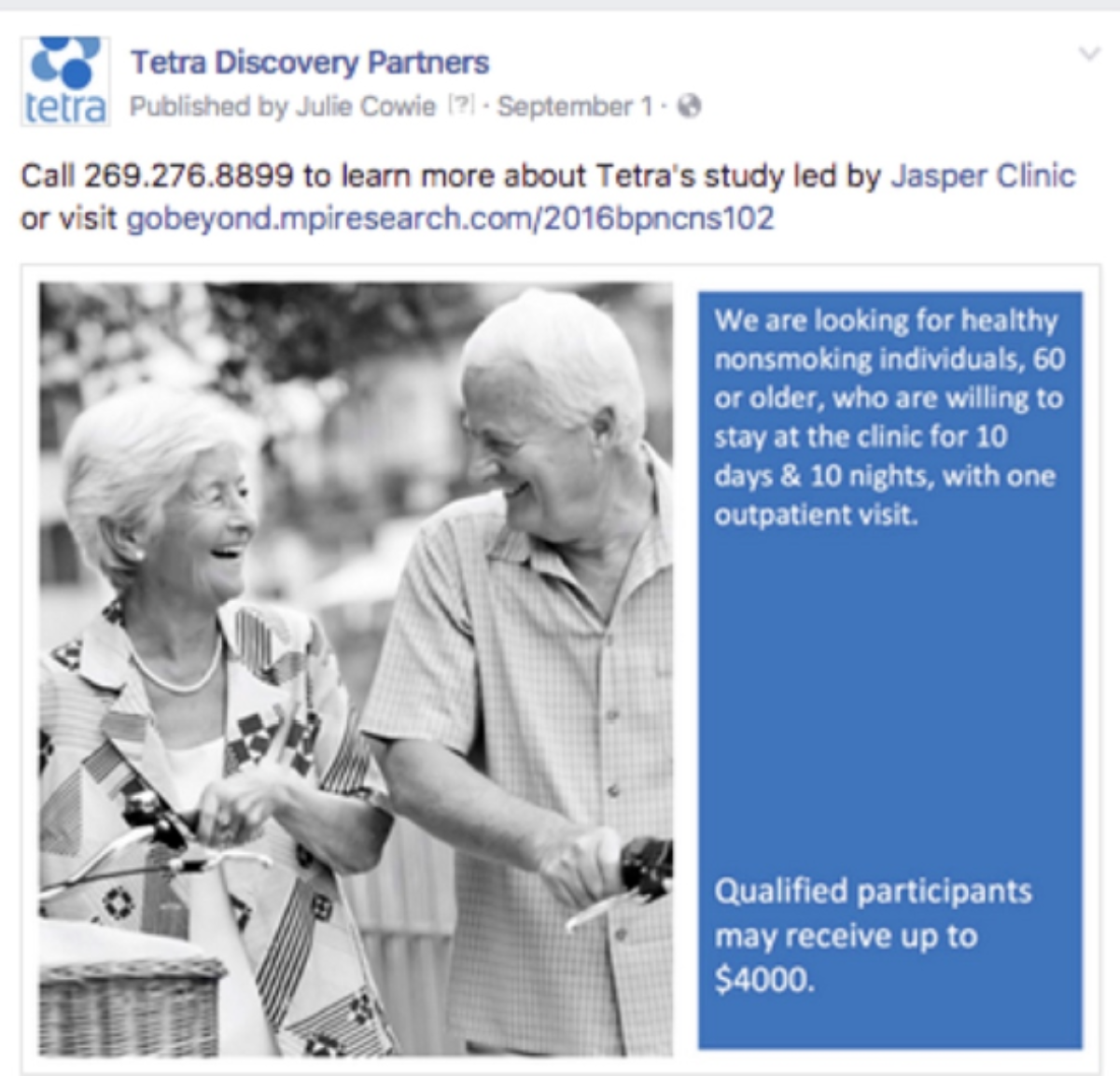
Tetra Discovery Partners, a Michigan drug developer, needed healthy nonsmokers aged 60 or older for a Phase 1 Alzheimer's disease memory drug trial that required a 10-day, 10-night clinic stay [24]. Traditional outreach had produced 178 inquiries in 11 weeks [24].
Its IRB-approved Facebook ad named the clinic, the eligibility criteria, the residential stay and the outpatient visit. It said qualified participants "may receive up to $4000", in the same type as the rest of the copy. Tetra later had new social-media text and photos approved by the IRB [24]. Over eight weeks, the campaign contributed to 868 inquiries, and the trial fully enrolled at 45 subjects [24].
Why it worked: The ad told older adults who could take part and what the stay involved before they called, and it stated the payment without emphasizing it, as FDA guidance allows [3]. The authors reported that older adults engaged with the ads at 4.92%, more than twice the click-through rates seen with younger adults [24]. For buyers, the lesson is that a plain, specific ad aimed at the right age group can outperform broad traditional outreach, provided each new creative version goes back to the IRB [13][24].
Sample 3: print, transit or radio spot
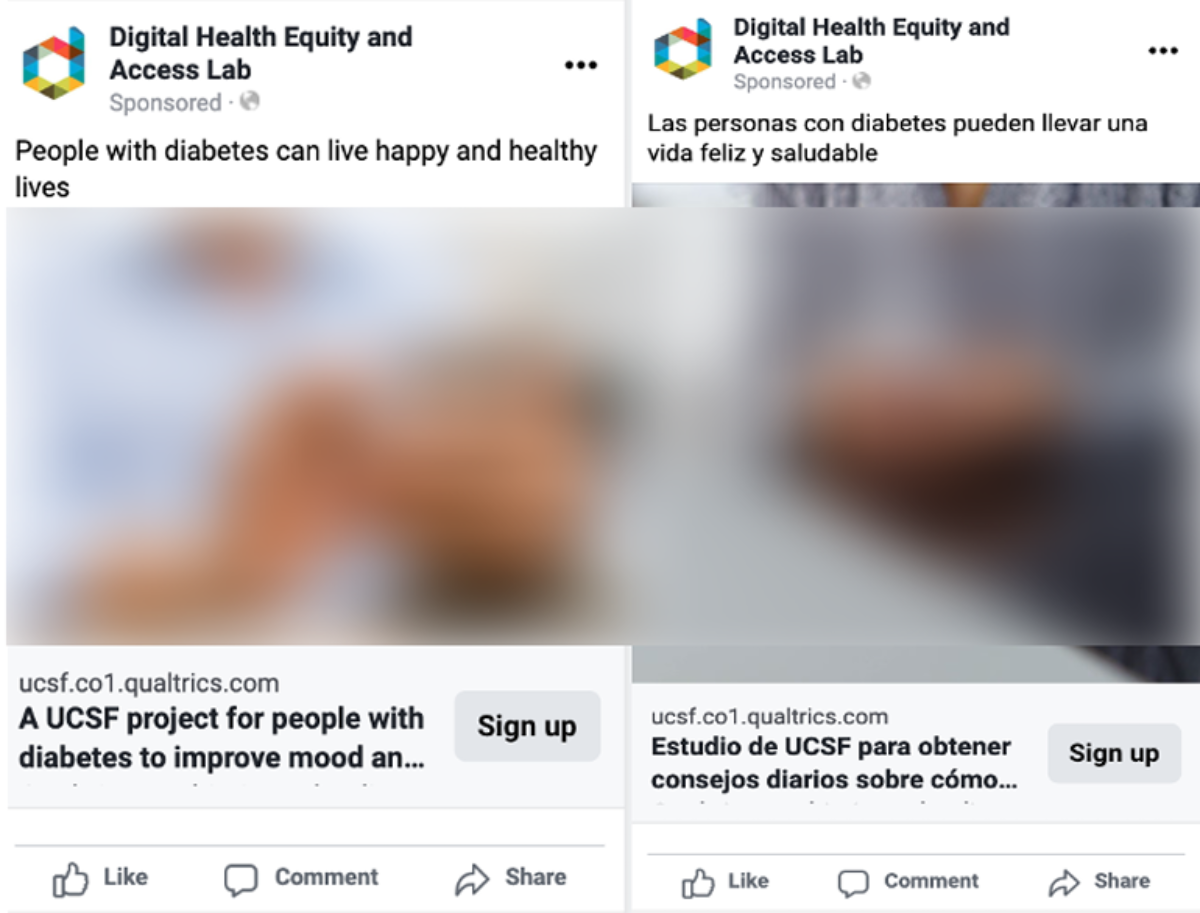
Researchers at the University of California, San Francisco (UCSF) ran English and Spanish Facebook ads for DIAMANTE, a smartphone program for adults with diabetes and depressive symptoms [23]. The headline read "People with diabetes can live happy and healthy lives", not "Do you have diabetes?" The team chose indirect phrasing because Meta's policy barred copy that asserted or implied a viewer's personal attributes [15][23]. Each ad linked to an online eligibility screener.
Between October 2020 and May 2021, the Facebook ads earned 418,173 impressions and 4,756 clicks and enrolled 26 participants at $80.16 each [23]. They enrolled no Spanish speakers, and the team stopped the Spanish ads because they cost more and produced fewer completed screeners [23].
Why it worked: The headline described a hopeful outcome for a group rather than a condition in the reader, so it passed Meta's review and still spoke to people with diabetes. The study team concluded that social media ads could recruit a diverse sample [23]. For buyers, the lesson is to ask a vendor how its copy stays compliant, and which second channel will reach audiences one platform misses [23].
How to brief a vendor on clinical trial advertising
A vendor moves only as fast as the approvals, so your brief should hand over what each reviewer will ask for.
1. The IRB of record and who submits. Initial submission or amendment sets the earliest launch date.
2. The protocol synopsis and eligibility summary. The ad can only draw on what the IRB has seen.
3. The consent form's payment wording. Matching it avoids a second review round.
4. The trial countries. Google's country list shapes the media plan.
5. The data path after the click. Who receives prescreener answers, under which HIPAA pathway, with what approved contact consent.
6. A change-control rule. Who approves variants, and how new versions return to the IRB.
With a shortlist in hand, the eight performance questions to put to any recruitment vendor test whether its numbers hold up.
If you would rather not run that evaluation alone, Refero screens healthcare marketing and patient recruitment agencies against five published criteria and introduces up to three that fit your brief. It is free for buyers, and there is no obligation to hire anyone we introduce. Tell us what you need.
Frequently asked questions
Do clinical trial ads need IRB approval?
Yes, in almost every case: FDA treats advertising for study subjects as the start of informed consent. The IRB of record therefore reviews the ad in its final print or broadcast form [3]. Revised versions need review before use [13]. Internet listings limited to basic trial information are exempt [3].
What can a clinical trial advertisement not say?
It cannot claim or imply that the product is safe, effective, or equivalent or superior to another. It also cannot call the product a new treatment, medication or drug without saying it is investigational [3]. It cannot promise free medical treatment when the meaning is no cost to take part, promise a cure, or emphasize payment [3].
Can a clinical trial ad mention payment?
Yes. FDA allows an ad to say participants will be paid, but not to emphasize the payment or amount through larger or bold type [3]. FDA classes payment as a recruitment incentive that IRBs review for undue influence [9]. An IRB may judge a specific amount coercive and allow only a line saying compensation will be offered [10].
Can you run clinical trial ads on Google and Facebook?
Yes, within each platform's rules, which apply after IRB approval. Google accepts trial recruitment ads in 22 countries from approved advertisers and bars any implication that the tested product is safe [1]. Meta bars copy that asserts or implies the viewer's health condition, so "Do you have [condition]?" headlines fail review [15].
Can a recruitment team call or text people who respond to a trial ad?
Yes, with the consent the TCPA requires: mobile calls that use an autodialer or an artificial or prerecorded voice need prior express consent [17]. The FCC's 2024 ruling puts AI-generated voices in the same category [18]. Vendors typically capture one consent covering calls and texts.
Sources
- Google. Clinical trial recruitment. Google Ads Advertising Policies Help, accessed 2026. Link
- Microsoft Advertising. Updates to our network policies. Microsoft Advertising blog, 2023. Link
- US Food and Drug Administration. Recruiting Study Subjects: Guidance for Institutional Review Boards and Clinical Investigators. FDA, 1998. Link
- Bramstedt KA. Recruiting Healthy Volunteers for Research Participation via Internet Advertising. Clinical Medicine and Research, 2007;5(2):91-97. Link
- 47 U.S.C. 227(b)(3), Restrictions on use of telephone equipment. Legal Information Institute, Cornell Law School. Link
- Tufts University Office of the Vice Provost for Research. Direct Advertising Material for Recruitment. Tufts University, accessed 2026. Link
- US Food and Drug Administration. Screening Tests Prior to Study Enrollment: Guidance for Institutional Review Boards and Clinical Investigators. FDA, 1998. Link
- 21 CFR 56.109, IRB review of research. Electronic Code of Federal Regulations. Link
- US Food and Drug Administration. Payment and Reimbursement to Research Subjects: Guidance for Institutional Review Boards and Clinical Investigators. FDA, 2018. Link
- University of Utah Institutional Review Board. Advertisements (Guidance Series). University of Utah, accessed 2026. Link
- 21 CFR 50.20, General requirements for informed consent. Electronic Code of Federal Regulations. Link
- 21 CFR 56.111, Criteria for IRB approval of research. Electronic Code of Federal Regulations. Link
- 21 CFR 56.108, IRB functions and operations. Electronic Code of Federal Regulations. Link
- University of Pittsburgh Human Research Protection Office. Advertisements. University of Pittsburgh, accessed 2026. Link
- Meta. Privacy Violations and Personal Attributes. Meta Transparency Center, Advertising Standards, accessed 2026. Link
- LinkedIn. Healthcare ads policy. LinkedIn Marketing Solutions Help, accessed 2026. Link
- 47 CFR 64.1200, Delivery restrictions. Electronic Code of Federal Regulations. Link
- Federal Communications Commission. Declaratory Ruling, FCC 24-17, CG Docket No. 23-362. FCC, 2024. Link
- 45 CFR 164.512(i), Uses and disclosures for research purposes. Electronic Code of Federal Regulations. Link
- 45 CFR 164.508, Uses and disclosures for which an authorization is required. Electronic Code of Federal Regulations. Link
- American Hospital Association v. Becerra, No. 4:23-cv-01110-P (N.D. Tex. June 20, 2024). Opinion and Order. US District Court for the Northern District of Texas, via GovInfo, 2024. Link
- Washington State Office of the Attorney General. Protecting Washingtonians' Personal Health Data and Privacy. Washington State AGO, accessed 2026. Link
More from Refero